

| News | |||||||||||||||||||||||||||||||||||||||||||||||||||||||||||||||||||||||||||||||||||||||||||||||||||||||||||||||||||||||||||||||||||||||||||||||||||||||||||||||
 Elon Musk has completed his $44 billion deal to buy Twitter, a source familiar with the deal told CNN Thursday. | |
Submitted at 10-28-2022, 01:29 AM by Mordant | |
1 Comment | |
 MOAB – As a Grand County sheriff's deputy searches for a shoplifting suspect in July, a rope repeatedly pops into view of her body camera, sometimes coiled in her hand and other times twirling in the air ahead of her.
The unusual sight draws questions from observers in Moab, and deputy Amanda Edwards answers them in an upbeat tone, telling them she's looking for an African American man.
"Are you going to lasso him?" one observer asks.
"That was my plan, man," the deputy responds in the video. "I mean, it's better than running, right?" | |
Submitted at 10-28-2022, 12:31 AM by The Livin' Burden | |
 On Christmas Eve 2016, Karlene Petitt, an international long-haul pilot for Delta Air Lines, received a devastating letter that threatened to end her career.
She had been grounded since March pending an evaluation by a company-assigned doctor. The letter informed her of his diagnosis: She was mentally unfit for duty and would not be permitted to fly again.
Petitt had then been flying commercial jets for 35 years. She’d raised three children, earned a doctorate and two master’s degrees and wrote a series of books, all while performing perfectly as a pilot.
In early November of the previous year, she had sent emails to her superiors criticizing Delta’s safety culture, initiating a series of interactions with them about safety issues.
Just six days later, captain Jim Graham, then Delta’s vice president of flight operations, in an email to a pilot manager under him, indicated clearly his intention to put a stop to Petitt’s critique and to do so using a Kafkaesque process called a “Section 15,” which would label her too mentally unstable to be a pilot.
“We should consider whether a Section 15 is appropriate,” Graham wrote. “If she cannot embrace and understand the reasons behind our actions, it stands to reason she might not be able to make appropriate decisions for the safe operation of a flight.” | |
Submitted at 10-27-2022, 08:38 PM by sleeppoor | |
 On Thursday's broadcast, he struck a very different tone and said he was wrong to trust the company's executives.
"Let me say this: I made a mistake here. I was wrong. I trusted this management team. That was ill-advised. The hubris here is extraordinary, and I apologize," Cramer said. "OK," said Faber. "What did you get wrong?"
Cramer explained that he did not expect Meta to spend as much as it had, calling it "almost a rogue situation."
"What did I get wrong?" he said, visibly choking up. "I trusted them, not myself. For that I regret. I've been in this business for 40 years, and I did a bad job. I'm not proud." | |
Submitted at 10-27-2022, 07:23 PM by Wreckard | |
 "Just think if they didn't have the drill," parent Ebony King said. "I'm thinking that it could have went wild, like the Texas shooting, where so many kids were lost. | |
Submitted at 10-27-2022, 05:53 PM by Forensic | |
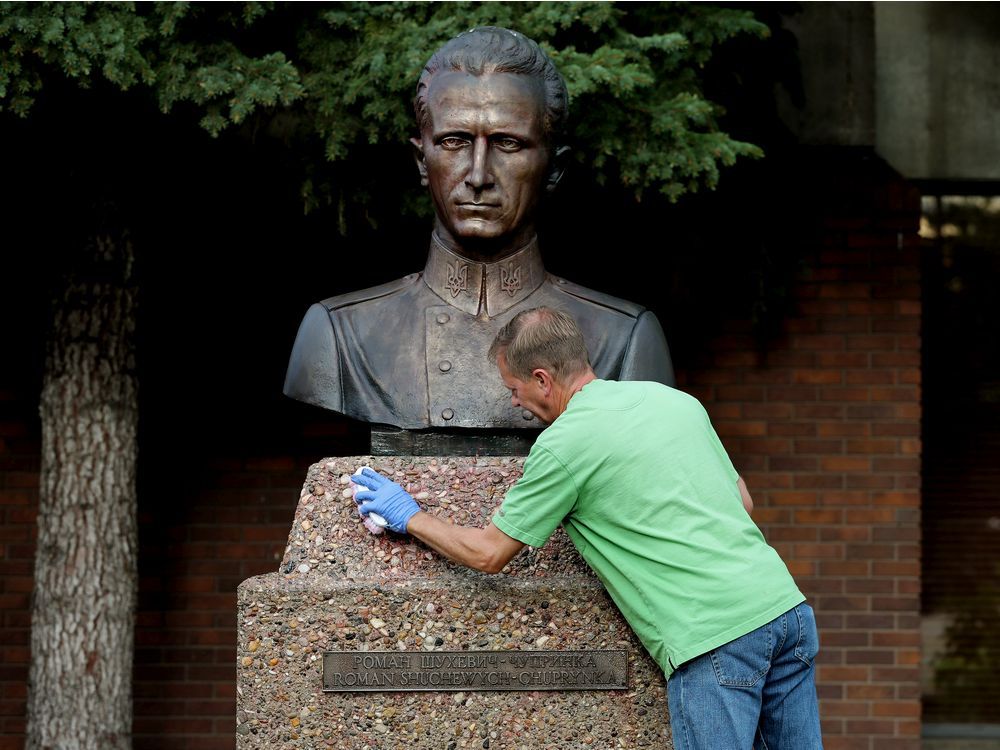 The operator of a progressive news outlet has been charged with mischief after a controversial statue outside an Edmonton Ukrainian centre was tagged with graffiti.
Article content
The Edmonton Police Service on Tuesday confirmed a charge of mischief under $5,000 was laid Oct. 14 against 39-year-old Duncan Kinney, related to an August 2021 incident of vandalism at the Ukrainian Youth Unity Complex in north Edmonton.
That month, the words “Actual Nazi” were written in red paint on the base of a statue of Roman Shukhevych, while a memorial at nearby St. Michael’s cemetery to Ukrainian soldiers who fought in the Second World War was painted with the words “Nazi Monument 14th Waffen SS,” a largely volunteer unit that drew from the Galicia region.
The presence of the Shukhevych statue has drawn the ire of Polish and Jewish groups, including the Friends of Simon Wiesenthal Center for Holocaust Studies, which called for the removal of the ’70s-era statue.
“Over the years he was in charge of a number of different military units, some of which were collaborating with the Nazi regime,” Jaime Kirzner-Roberts, director of policy at FSWC, said in 2021. “They were engaging in the genocide of the Jewish population as part of the program of the Holocaust. They also were committing massacres on Polish civilians.” | |
Submitted at 10-27-2022, 04:47 PM by sleeppoor | |
 New research by a team of archaeologists has revealed a curious connection between our traditional Thanksgiving dinner and the taste buds of prehistoric mammoths and mastodons. | |
Submitted at 10-27-2022, 08:39 AM by Grief Bacon | |
 How is this real? | |
Submitted at 10-27-2022, 06:58 AM by Mordant | |
 A
fter sailing to victory in the Republican primary for Georgia’s Senate seat in May, Herschel Walker is now set to face incumbent Raphael Warnock in the general election this November. Donald Trump, who once owned a professional football team that counted Walker as its star player, is far from the only billionaire supporting the former running back. In fact, a half dozen other members of the World’s Billionaires List have donated $100,000 or more apiece to support his candidacy.
The most generous among them is Bernie Marcus, cofounder of Atlanta-based Home Depot. A longtime GOP donor, Marcus handed $1.75 million to a super PAC called 34N22. That group has concentrated its efforts on supporting Walker, who wore No. 34 when he won the Heisman trophy at the University of Georgia and is now hoping to win a Senate seat in 2022.
Industrialist Dennis Washington donated another $500,000 to 34N22. A representative of Washington named Larry Simkins explained that Walker has long been close with the Washington family and has spent time with them in Montana, but did not elaborate on how they met. A representative of the Walker campaign did not respond to a request for comment.
Investors Charles B. Johnson and Nelson Peltz each kicked in $100,000. Oil-and-gas magnate Trevor Rees-Jones and his wife Jan both wrote checks to 34N22 for $50,000. Ex-casino mogul Steve Wynn — who resigned as the finance chair of the Republican National Committee amid sexual misconduct allegations — donated $100,000 with his wife, Andrea. | |
Submitted at 10-27-2022, 02:05 AM by sleeppoor | |
 The U.S. Department of Justice launched the probe last year following more than a dozen crashes, some fatal, involving Tesla’s driver assistance system Autopilot, people familiar with the matter say. | |
Submitted at 10-27-2022, 01:48 AM by sleeppoor | |
 PASO ROBLES, Calif. — The kiosk at this corner gas station just off Highway 101 in California’s hilly Central Coast warns that you’re on your own: “The attendants at this store cannot help you with this machine.”
The kiosk stands right beside a more typical cash-withdrawal ATM, with an identical keypad and slot for a plastic card. But it’s bigger and glitzier, with a brightly colored screen like a casino slot machine. It takes your cash and converts it to Bitcoin in a virtual wallet.
Welcome to the world of cryptocurrency ATMs, also known as “BTMs” (the B is for Bitcoin), which have mushroomed in the past several years, even if most people don’t understand exactly what they’re for. The precise number of these machines in the United States seems to depend on who’s counting, but most analyses put it at about 34,000. That’s nearly 90 percent of the world’s total tally. Canada ranks a distant second with an estimated 2,500.
Crypto fans and crypto companies see the machines as an extension of the promise embodied by Bitcoin, the largest cryptocurrency: another step in the democratization of finance. Everybody knows what an ATM is, and allowing people to buy crypto with cash opens this new landscape of exchange and investment up to anyone. You can’t buy into Wall Street investments without a bank account and a brokerage account. BTMs offer the hourly worker on a lunch break the option to buy crypto instead of a lottery ticket.
But as they’ve proliferated, state regulators across the country, and even some federal officials, have started to raise concerns. Legitimate companies may run most of these machines, but some are set up by unlicensed operators. The regulators worry that crypto ATMs can too neatly serve the interests of money launderers and fraudsters, or could hide payments to sex and drug traffickers; even for honest brokers, their fees are considerably higher than normal bank transactions. They also market themselves, sometimes aggressively, to low-income people who may not understand the risks of moving their money into cryptocurrency, which is currently in the midst of one of its intermittent crashes.
States are trying to figure out how to handle these machines at a time when they’re still grappling with what to do about crypto itself. In most states, banking officials head up the task of sorting through policy. And in most states, they haven’t yet explicitly decided that digital money trades need the same kind of money transmitting licenses that govern traditional finance. | |
Submitted at 10-27-2022, 01:11 AM by sleeppoor | |
 Pegasus spyware was deployed against journalists and human rights watchdogs in Mexico between 2019–2021, despite the government promising that they would stop using it.
The hacks came after President Andrés Manuel López Obrador promised that the Mexican government would not use Pegasus to intimidate critics, in direct contrast to the actions of his predecessor, Enrique Peña Nieto.
According to Citizen Lab—which helped Mexican digital rights group R3D verify the attacks it detected on human rights defender Raymundo Ramos, journalist Ricardo Raphael, and an anonymous contributor to media outlet Animal Politico—“each of the victims would be of intense interest to entities within the Mexican government and in some cases, troublingly, to cartels.”
Taking aim. Pegasus attacks mobile devices. One of the exploits used against Raphael used a text shared link, similar to a spam email, that installed malware on his phone.
“Today, as we’ve all moved our worlds onto our phones, one of the biggest and most hard-to-defend-against threats against high-risk people of any sort are threats around mobile phone security and mobile malware,” said Citizen Lab Senior Researcher John Scott-Railton.
Railton told IT Brew that Citizen Lab has begun to see an increase in “zero-click exploits”—hacks of mobile phones that don’t require clicking on a link or the user taking any action. Instead, the attack uses an existing vulnerability to gain access and install malware.
The extent to which the malware can infiltrate your mobile device goes beyond just reading messages and emails and downloading data. With keychain apps, it’s possible that adversaries could use the cloud to access the totality of your information from laptops and other devices.
And if you don’t catch it in time, you could never detect it. | |
Submitted at 10-27-2022, 01:07 AM by sleeppoor | |
 After the deadly insurrection on Jan. 6, 2021, a number of corporate political action committees, including Dallas-based AT&T, declared that they would pause support for candidates who voted to object to the certification of the 2020 election.
The political action committees for Valero Energy and the National Association of Realtors announced after the attack that they were suspending all political contributions.
But this election cycle, those companies and several other corporations have lavished funds on Texas Republicans who voted against certifying the election in 2020, plus a handful of new candidates who continue to cast doubt on the legitimacy of Joe Biden’s presidency. On the day of the insurrection, 17 Texans in Congress voted against certifying the election results — including Sen. Ted Cruz, who is not up for reelection this year, and 16 House members. (Of the House members, Rep. Louie Gohmert, of Tyler, is not seeking reelection, and Rep. Ron Wright, of Arlington, died in February 2021.) Many of those candidates continue to cast doubt on the election results, which have been affirmed by multiple audits, court decisions and even members of former President Donald Trump’s administration.
This year in Texas, AT&T-affiliated PACs have given at least $28,500 to lawmakers who objected to the certification of the 2020 election. Those lawmakers who received the funds are Republican Reps. Jodey Arrington of Lubbock, John Carter of Round Rock, Roger Williams of Austin, Michael Cloud of Victoria, Pete Sessions of Waco, Beth Van Duyne of Irving, Ronny Jackson of Amarillo and Lance Gooden of Terrell.
AT&T said in a statement to The Texas Tribune that its employee PACs donated to candidates in both parties focusing “on policies and regulations that are important to investing in broadband networks.” | |
Submitted at 10-27-2022, 01:04 AM by sleeppoor | |
 At the height of the coronavirus pandemic, Congress chartered a first-of-its-kind federal effort to help struggling Americans who could not afford to lose access to the internet. The generous aid proved to be a godsend for millions of low-income families, but it also sent the nation’s telecom giants scrambling for the new federal money — unleashing price hikes, service cuts and fraud risks that hurt customers and taxpayers alike.
The story of the government’s roughly $17 billion effort to close the country’s persistent digital divide is one of great promise and costly peril. Under the program, Washington offered to pay stipends directly to internet providers that lowered Americans’ monthly broadband bills — potentially to zero. But this simple premise at times brought complicated, undesirable results.
In the earliest days of the program, telecom giants including AT&T, Charter Communications and Verizon forced customers to accept price increases or slower connection speeds if they wanted to apply federally funded discounts to their bills, according to complaints filed with the FCC and later obtained by The Washington Post under federal open-records laws. | |
Submitted at 10-27-2022, 01:04 AM by sleeppoor | |
 Ben Smith's news outlet promised to be "something new," but it's spreading tired fossil fuel industry propaganda just like the rest. | |
Submitted at 10-27-2022, 01:02 AM by sleeppoor | |
 Queer beaches are resilient community spaces. But they are also contested ones, and many have disappeared. | |
Submitted at 10-27-2022, 01:01 AM by sleeppoor | |
 Athletic shoe company Skechers said in a statement Wednesday that two of its executives escorted embattled musician Kanye West from one of its Los Angeles buildings.
The company said West, who has legally changed his name to Ye, “arrived unannounced and without invitation.” It said he was engaged in “unauthorized filming” and he was escorted out “after a brief conversation.” | |
Submitted at 10-27-2022, 12:27 AM by Irn-Bru | |
 BALAKLIIA, Ukraine – The Russian soldiers had fled weeks before. But they left their traces everywhere.
Concrete steps led into the basement of their hastily abandoned headquarters in this small riverside town in eastern Ukraine. A bunker smelling of damp lay behind a steel door marked “Command Group.” Papers, some charred, were stuffed into a furnace. Others were scattered across the floor.
In a floral notebook, an unnamed staff officer left a sketch of a cartoon soldier and mused about going home. The book’s 91 handwritten pages contained other information, too: coordinates of Russian intelligence units, records of calls from commanders, details of battles, men killed and equipment destroyed. And accounts of a breakdown in morale and discipline. | |
Submitted at 10-26-2022, 04:56 PM by Forensic | |
 Ye rejected the offer on the "Drink Champs Podcast" and reportedly said Planned Parenthood was his Holocaust museum. | |
Submitted at 10-26-2022, 04:46 PM by Mordant | |
 A previously unreported boom in profits for the shipping supply giant Uline has provided the funds for a deeply conservative Midwestern family to bankroll anti-democracy causes around the country. | |
Submitted at 10-26-2022, 03:32 PM by sleeppoor | |