

| News | |||||||||||||||||||||||||||||||||||||||||||||||||||||||||||||||||||||||||||||||||||||||||||||||||||||||||||||||||||||||||||||||||||||||||||||||||||||||||||||||
 Professional wrestler Marty Jannetty, best known for his time in WWE as a member of the legendary tag team “The Rockers” with Shawn Michaels, confessed to committing murder when he was 13 years old in a rambling, bizarre Facebook post. | |
Submitted at 08-27-2020, 11:21 AM by Velveteen Touch | |
1 Comment | |
 Breaking news: Scott Adams has uncovered the truth about Joe Biden as a disciple of Satan! From Right Wing Watch: “Build back better—BBB. If you were going to imagine ‘666’ and you wanted to show i… | |
Submitted at 08-27-2020, 12:15 AM by self righteous trilobite | |
 Three socialists ran in this month’s Tennessee primaries. With endorsements from the Memphis chapter of Democratic Socialists of America, all three of them won. | |
Submitted at 08-27-2020, 05:04 AM by sleeppoor | |
 Arson is suspected as the cause of a July 12 fire that left extensive damage to the USS Bonhomme Richard docked off San Diego, and a U.S. Navy sailor was being questioned as a potential suspect, a senior defense official said Wednesday.
The sailor was being questioned as part of the investigation by the Naval Criminal Investigative Service and the Bureau of Alcohol, Tobacco, Firearms and Explosives, the official said, adding that defense department leaders were notified of the development. The official, with knowledge of the investigation, spoke to The Associated Press on condition of anonymity to provide details not yet made public. The sailor was not detained.
The amphibious assault ship burned for more than four days and was the Navy’s worst U.S. warship fire outside of combat in recent memory. | |
Submitted at 08-27-2020, 03:18 AM by Xiphias | |
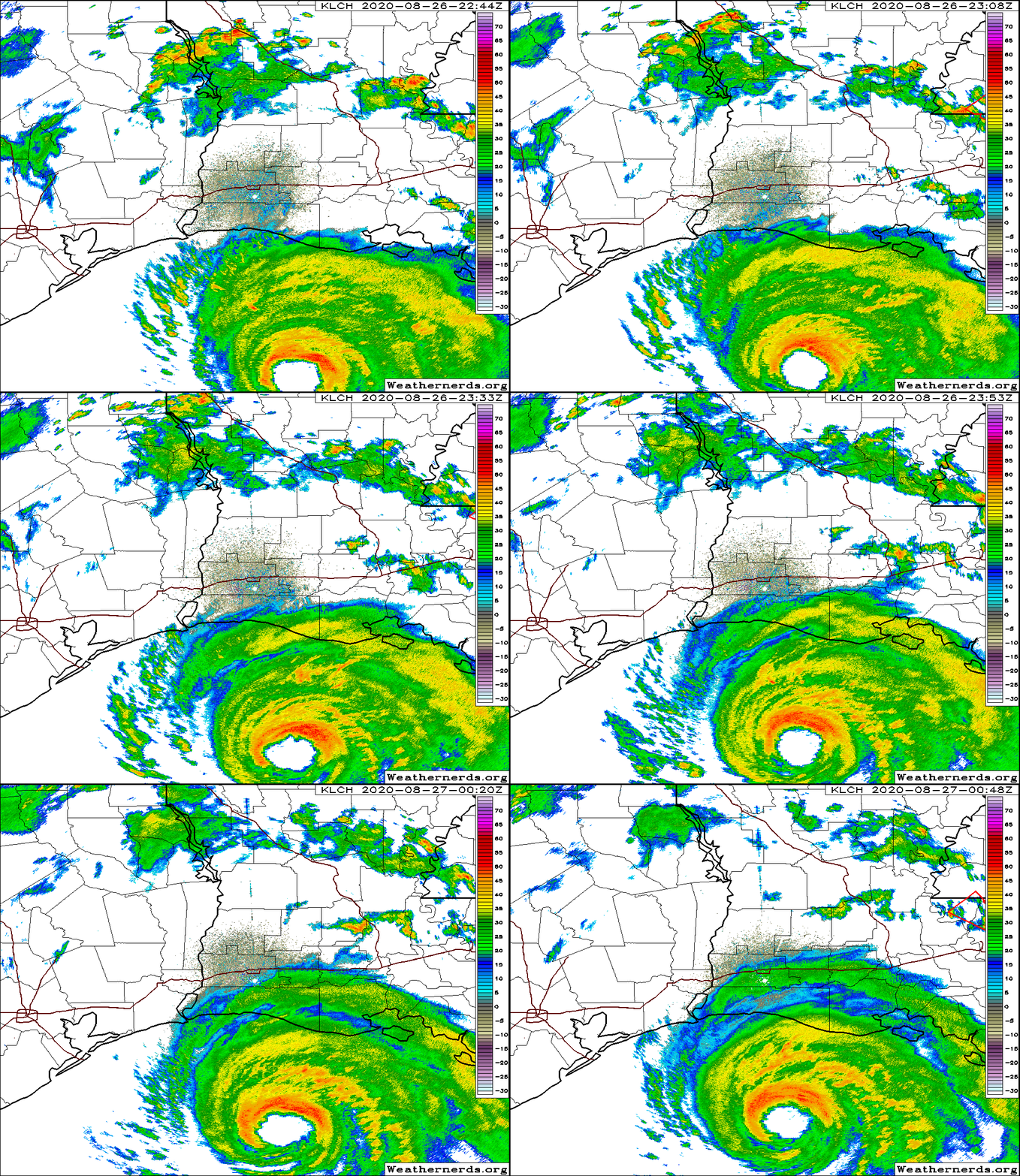 POSTED AT 8:20 PM CT WEDNESDAY: Hurricane Laura has made its turn to the north in earnest late this afternoon and evening, and is likely heading for landfall on the Louisiana coast, possibly near Calcasieu Pass, south of Lake Charles. | |
Submitted at 08-27-2020, 03:02 AM by Xiphias | |
 UPDATED with Seattle game postponed: The Milwaukee Brewers’ scheduled home game against the Cincinnati Reds on Wednesday was postponed after Brewers’ players met earlier in the afternoon and decided to boycott the game in the wake of the police shooting of Jacob Blake.
Later in the afternoon, the Seattle Mariners-San Diego Padres game scheduled for 6:10 p.m. PT at Petco Park was also postponed.
The MLB news, reported by multiple outlets, follows earlier in the day the NBA having to postpone its three scheduled playoff games tonight in Orlando, a move prompted by players on the Milwaukee Bucks not taking the floor for pregame warmups for their game against the Orlando Magic. | |
Submitted at 08-27-2020, 12:42 AM by Xiphias | |
 Shortly after 9 PM on December 30, 2007, Mwai Kibaki held a Bible in his right hand and was sworn in for a third term as Kenya’s president. It was a hurried, late-night provocation that even the most authoritarian administrations had never before attempted. Just a few hours earlier, the Electoral Commission of Kenya (ECK) had declared Kibaki the winner of the election held on December 27. The ECK did this knowing the opposition had accused the government of rigging the vote. In hindsight, the swearing-in was the culmination of events that constitute an inflection point for Kenya—one with lessons for any fragile democracy, but especially for the United States under President Donald Trump.
Election day had been marred by protest. Junior officers at the ECK had even gone on national television and radio to warn the public that the results were being manipulated. Then, in the early hours of the next morning, Kibaki suddenly and rapidly reversed a nearly 1 million-vote deficit against his main challenger, Raila Odinga. Some constituencies recorded voter turnouts of over 100 percent.
The opposition disputed the results, and the contest of wills between Kibaki and Odinga, the kingpins of the two major political camps, triggered protests and police crackdowns, which were followed by outbreaks of ethnic violence that killed more than 1,500 people and displaced hundreds of thousands over the next four months. Eventually, after regional and international intervention, Kibaki agreed to a coalition government, where he remained president. | |
Submitted at 08-27-2020, 01:37 AM by Forensic | |
 Armed citizens have been taking to the streets of Kenosha during unrest in the city following the police shooting of Jacob Blake and some have even asked the county sheriff to deputize them, Kenosha County Sheriff David Beth said.
Beth, speaking during a press conference Wednesday, said he declined to do so, noting that if he did, those members would become "a liability to me and the county and the state of Wisconsin."
"There's no way. There's no way I would deputize people," he said.
Beth, who said his initial response was "oh hell no," added that such groups don't actually help police.
"Part of the problem with this group is they create confrontation," he said. "People walking around with guns - if I walk in my uniform with a gun all of you probably wouldn't be too intimated by it because you're used to officers having guns, but if I put out my wife with an AR-15 or my brother with a shotgun or whatever it would be walking through the streets you guys would probably wonder what the heck was going on." | |
Submitted at 08-27-2020, 12:52 AM by Forensic | |
 Up until recently, sexual assault survivors were free to share their experiences with the world.
Changes to the Judicial Proceedings Reports Act now make this impossible in Victoria - otherwise, survivors risk spending months in jail or copping thousands of dollars in fines.
The laws apply to sexual assault survivors whose abusers have been found guilty of their crimes, or whose cases are still before the courts. | |
Submitted at 08-26-2020, 11:27 PM by ButterMILF Paincakes | |
Submitted at 08-26-2020, 10:17 PM by Xiphias | |
 U.S. adults are more inclined now than in 1988 to say nonviolent protest, violent protest and economic boycotts, in particular, can help improve the situation of Black Americans. | |
Submitted at 08-26-2020, 10:16 PM by Xiphias | |
 Justin Townes Earle likely died from a “probable drug overdose,” a spokesperson at the Metro Nashville Police Department confirmed to Rolling Stone on Tuesday. Police conducted a welfare check at the 38-year-old songwriter’s Nashville apartment on Sunday after one of Earle’s friends said they hadn’t heard from him since Thursday. MNPD spokesperson Don Aaron told Rolling Stone that the Nashville Fire Department entered the residence and found Earle dead. An autopsy is pending. | |
Submitted at 08-26-2020, 09:34 PM by sleeppoor | |
 When federal agent Jim Reed drove in to a small airport in the East Texas city of Athens mid-morning on September 15, 2014, he was expecting to find a straightforward case of arson—an easy case for the new guy. He introduced himself to the Athens Jet Center’s co-owners, two brothers in their seventies named Wayne and Gaylon Addkison, who led Reed to a small jet, a 1971 Cessna 500 Citation I, that looked like it had been barbecued on a rotisserie. “It was burned in half,” Wayne Addkison recalled. “The nose tipped on the ground and the back half was on the ground too.”
For two weeks the Citation had just been sitting on the tarmac at Athens Municipal Airport, next to the Jet Center, they told Reed. But two days before Reed’s visit, they’d come into work after receiving a call: the plane was in flames. Reed, a fit 29-year-old who was as careful with his clean-cut brown hair and clean-shaven face as he was with his deposition-ready phrasing, was only six months into his job as an agent for the Bureau of Alcohol, Tobacco, Firearms, and Explosives (ATF). Reed didn’t doubt that the fire was the result of arson: A mechanical failure on an inactive Citation was about as unlikely as a lightning strike. As one pilot would later say, “Planes don’t just catch fire in a hangar. They don’t spontaneously combust.” Driving out from Tyler, where he was based, Reed considered the typical arsonists who might be involved. Was this a teen vandal? A local troublemaker?
Later, when he reviewed the airport’s surveillance footage, he could see a shadow of a man thrown from the plane in a ball of fire when it exploded. He checked the area burn centers, hospitals, and morgues. Nobody had turned up with burns. Whoever set fire to the plane had somehow walked away in one piece. | |
Submitted at 08-26-2020, 09:31 PM by sleeppoor | |
 Hurricane Laura, a major Category 4 storm, is set to hit near the Texas-Louisiana border on Thursday morning as local officials scramble to evacuate thousands of residents.
The storm’s rapid intensification shocked scientists and prompted forecasters to issue warnings of “unsurvivable storm surge” in Texas and Louisiana.
“Unsurvivable storm surge with large and destructive waves will cause catastrophic damage from Sea Rim State Park, Texas, to Intracoastal City, Louisiana, including Calcasieu and Sabine Lakes,” the National Hurricane Center said on Wednesday. “This surge could penetrate up to 30 miles inland from the immediate coastline.”
Laura could bring storm surge of nearly 13 feet to the coastline as well as flash flooding and tornadoes on land. The storm battered the Dominican Republic, Puerto Rico and Haiti over the weekend, knocking out power for more than 1 million people, collapsing some homes and killing at least 23 people. | |
Submitted at 08-26-2020, 08:06 PM by Xiphias | |
 Scott Adams, the creator of the Dilbert comic strip and a popular pro-Trump commentator online, is not a religious believer, but he told followers Tuesday that he couldn’t help but notice how many “satanic coincidences there are with the Joe Biden campaign.” | |
Submitted at 08-26-2020, 07:11 PM by Xiphias | |
 Beyond wildfire smoke, the air quality in Denver has deteriorated to exceptionally poor conditions with residents barraged by infusions of multiple lung-irritating pollutants — including ozone, which has spiked in recent days to levels 28% above federal health limits.
Ground-level ozone levels in metro Denver this week reached as high as 90 parts per billion, exceeding the health limit of 70 ppb, state monitoring data shows. Ozone levels at 11 of the 15 air-testing sites broke that health limit. Ozone causes acute respiratory problems and triggers asthma attacks.
Colorado public health officials issued a special “multiple pollutants” alert through at least 4 p.m. Tuesday. Health authorities focused most urgently on the harm from inhaling tiny “particulates” spreading in the smoke from burning forests and grasslands. California’s big fires brought more smoke, thickening the haze from the four major fires still burning across more than 193,000 acres in western Colorado. | |
Submitted at 08-26-2020, 07:09 PM by Forensic | |
 Mental disorders are routinely treated by medication under the medical model. So why are the anthropologists who wrote this study claiming that these disorders might not be medical at all? They point to a few key points. First, that medical science has never been able to prove that anxiety, depression or post-traumatic stress disorder (PTSD) are inherited conditions.
Second, the study authors note that despite widespread and increasing use of antidepressants, rates of anxiety and depression do not seem to be improving. From 1990-2010 the global prevalence of major depressive disorder and anxiety disorders held at 4.4% and 4%. At the same time, evidence has continued to show that antidepressants perform no better than placebo.
Third, worldwide rates of these disorders remain stable at 1 in 14 people. Yet “in conflict‐affected countries, an estimated one in five people suffers from depression, PTSD, anxiety disorders, and other disorders,” they write.
Taken together, the authors posit that anxiety, depression and PTSD may be adaptive responses to adversity. “Defense systems are adaptations that reliably activate in fitness‐threatening situations in order to minimize fitness loss,” they write. It’s not hard to see how that could be true for anxiety; worry helps us avoid danger. But how can that be true for depression? They argue that the “psychic pain” of depression helps us “focus attention on adverse events... so as to mitigate the current adversity and avoid future such adversities.” | |
Submitted at 08-26-2020, 06:30 PM by blicero | |
 Residents across Nottinghamshire can expect to find more spiders crawling into their homes over the next few weeks - and this is why.
Male house spiders - which can have a leg span of up to 10cm - are on the prowl looking for female spiders to be their mating partner.
August and September is the mating season and they are attracted to warm and dry areas which is usually in people's homes, sheds or garages.
Dr Chris Terrell-Nield, ecology lecturer at Nottingham Trent University who has been involved in a number of spider projects for Nottinghamshire Wildife Trust explains the situation.
He said people can expect to find three types of spiders at this time of year - the house spider, the daddy long leg spider and the cross spider. | |
Submitted at 08-26-2020, 05:16 PM by Xiphias | |
 Since before recorded history, Indonesia has been the world’s vortex of natural catastrophe, largely due to its location: The nation of 17,500 islands could not be in a worse place tectonically, within the “Ring of Fire,” a huge, horseshoe-shaped seismic zone that stretches east all the way to California’s San Andreas Fault and Washington state’s Mount St. Helens. Just west of the Ring is the Alpide Belt, the world’s next-most seismically active zone. Together, the Ring of Fire and the Alpide account for 95% of all the world’s known earthquakes since the last ice age 11,700 years ago, and all but three of the 25 largest volcanic eruptions. Four of the six biggest earthquakes this century have occurred in Indonesia, and three of the 10 deadliest. In the latter category, it’s the only country to be listed more than once.
Between volcanoes, earthquakes, tsunamis, and disease, no single place has inflicted anywhere near the same scale of disaster on itself and the rest of the planet. A 2004 earthquake near Sumatra killed some 227,000 people in 14 countries. In 2018, Indonesia was responsible for nearly half of all the world’s disaster-related deaths. But nothing before or since appears to have equaled the ferocity of the supervolcano Toba, which wiped out nearly every human on the planet 75,000 years ago, according to some scientists. The few thousand surviving Homo sapiens had to more or less start over.
In the context of such history, you might not expect Indonesians to be easily spooked by word of another disaster, and a slow-moving one at that. But that would be wrong. The country’s latest tribulation has shaken people: Jakarta is sinking into the sea. In 2030, it will be the world’s most populous city, surpassing Tokyo, but just two decades later — in 2050 — it will also probably be largely under water. Already, at least 20% of the city sags below sea level. | |
Submitted at 08-26-2020, 05:17 PM by crote | |
 When Microsoft began talking this summer with the popular video app TikTok and its Chinese parent company, ByteDance, no one had any intentions of pursuing a blockbuster deal.
With tensions swirling between the United States and China, along with the complexities of running a social media company, any large acquisition appeared too treacherous to navigate. So Microsoft discussed taking a small stake in TikTok and becoming one of the app’s minority investors, said four people briefed on the conversations.
Even a small deal would be a win-win, the thinking went.
For Microsoft, a minority investment would potentially bring TikTok over to using its Azure cloud computing service, immediately making the app one of Microsoft’s biggest cloud clients, said the people, who declined to be identified because the details are confidential. (TikTok has been using Google’s cloud computing services to power its videos.)
For ByteDance and TikTok, a deal with Microsoft could help propel the valuation of the app’s business outside China to as high as $80 billion, the people said. It would also provide TikTok with the endorsement of a blue-chip American company to mollify the Trump administration, which had called TikTok’s Chinese ties a national security threat.
Yet what started as discussions about a small investment morphed into a big, messy, political soap opera. Pushed by President Trump, who has ordered TikTok’s U.S. operations to be sold or to cease operating, ByteDance is now discussing selling parts of TikTok’s global operations to several potential bidders. And with so many groups jumping into the talks to get a piece of any deal, all are trying to drive their own interests and agendas.
Apart from Microsoft, the bidders include Oracle, the enterprise software company, the people with knowledge of the talks said. Bankers and investors, some authorized and some simply trying to gin up a deal, have also called Netflix and Twitter about buying TikTok, they said, though it is unclear if those companies have a genuine interest in an acquisition. Microsoft, with the deepest resources and a market value of more than $1.6 trillion, still appears the furthest along for now, the people said.
The sale scenarios on the table are head-spinning, the people said, because all of the parties — ByteDance, TikTok, their investors, and the bidders — want to get the most out of any deal. The talks have covered everything from selling just TikTok’s North American operations all the way to every part of TikTok, minus ByteDance’s Chinese-only video app Douyin, they said.
A deal price is unclear, though numbers have ranged from $20 billion to $50 billion depending on what parts of TikTok will be sold, the people said. The talks are fluid and no deal may ultimately be reached.
Even if one does take place, a TikTok sale — which has become a referendum on the U.S.-China relationship — may still be disrupted if Beijing or Mr. Trump weigh in. Mr. Trump has been highly involved, including talking to Microsoft’s chief executive, Satya Nadella, and saying that Oracle could handle buying TikTok. In an Aug. 6 executive order, he imposed a deadline for TikTok’s U.S. operations to be sold by Sept. 15.
On Monday, TikTok sued the U.S. government, arguing that the executive order had deprived it of due process. The suit could give TikTok more time to operate in the United States if the courts order it, a stalling tactic that may help the app wait it out past the Nov. 3 election.
Steven Davidoff Solomon, a law professor at the University of California in Berkeley, who contributes to The New York Times, said the United States’ forcing such a huge company to sell itself was “really unprecedented.” He added, “This is a forced sale, and ByteDance is trying to keep it from being as much of a fire sale as possible.”
This account of TikTok’s deal discussions was based on interviews with more than a dozen people who were involved in or were briefed on the situation. They spoke on condition of anonymity because they were not authorized to speak publicly.
Representatives from TikTok and ByteDance, Microsoft, Netflix, Twitter, Oracle and the White House declined to comment.
A spokesman for China’s Foreign Ministry, Wang Wenbin, called Mr. Trump’s executive order a “naked act of bullying,” and added that the U.S. government would eventually “reap what it sows.”
TikTok, which ByteDance created partly out of a $1 billion purchase of the lip-syncing app Musical.ly in 2017, has become a phenomenon in the United States and elsewhere. More than 100 million Americans regularly use the app, the company has said, especially teenagers and twentysomethings.
Last year, as tensions between the United States and China grew worse, the Trump administration began scrutinizing TikTok and ByteDance. In November, the Committee on Foreign Investment in the United States, a powerful panel known as Cfius that reviews foreign acquisitions, opened an inquiry into ByteDance’s deal to buy Musical.ly after lawmakers voiced concerns that TikTok was giving data on its American users to Beijing.
TikTok has denied that it helps Beijing. To reduce the U.S. pressure, Zhang Yiming, ByteDance’s chief executive, began consulting with a small group of investors in his internet company, including Sequoia Capital and General Atlantic. ByteDance, which is privately held, has been valued at about $100 billion.
Doug Leone, one of Sequoia’s partners, and Bill Ford, chief executive of General Atlantic, became Mr. Zhang’s bridge to the White House, the people with knowledge of the talks said. In their conversations, the Trump administration had specific stipulations: First, it wanted TikTok to overhaul its governance and shareholder structure to reduce ByteDance’s ownership of the app. Second, it wanted guarantees that TikTok’s American user data be stored on U.S. servers.
The firms needed a major U.S. tech partner to get the deal done, the people close to the talks said. Mr. Zhang and the investors figured that Facebook, Google and Amazon were under too much antitrust scrutiny. But Microsoft, with its cash hoard of $137 billion, cloud expertise and strong government relationships, could work.
Mr. Zhang, a former Microsoft engineer, reached out to Microsoft executives to gauge their interest, said one person with knowledge of the talks. Sequoia and General Atlantic declined to comment.
By July, Microsoft joined the talks. At the time, the discussions centered on Microsoft making a minority investment in TikTok, the people said. Between the U.S.-China tensions and the pressures of operating a social media company, Microsoft executives were hesitant about a big deal, said people briefed on the conversations. ByteDance and Mr. Zhang also wanted to retain some ownership of TikTok, they said.
Yet as the talks progressed, Microsoft grew warmer on a potentially larger deal with TikTok. While Microsoft has lots of data about industries like gaming and workplace software, it has little information about people’s social media behavior. TikTok’s user interaction information could strengthen Microsoft’s data science operation, the people briefed on the talks said.
TikTok could also be linked to Microsoft’s $7 billion advertising business. Together, that could make a meaningful difference to Microsoft’s growth, they said.
ByteDance and Microsoft came to see an acquisition of TikTok’s U.S. operations as a cleaner option, they added. Microsoft could allow TikTok to operate as a stand-alone unit, similar to how it had treated past large acquisitions, such as its $2.5 billion acquisition of the company behind the video game Minecraft in 2014 and its $26 billion purchase of professional networking site LinkedIn in 2016.
All the while, Trump administration officials were keeping an eye on the situation. Last month, Treasury Secretary Steven Mnuchin, who is chairman of Cfius and holds the final word on the panel’s recommendations of ByteDance’s purchase of Musical.ly, spoke with TikTok and Microsoft about how TikTok’s data should be on U.S. servers, three of the people said.
On July 31, Mr. Mnuchin presented the Cfius analysis of the ByteDance-Musical.ly deal to Mr. Trump, two people said. The recommendation: that ByteDance be ordered to sell TikTok to an American owner, with Microsoft acquiring most of TikTok’s business and the stakes held by ByteDance’s Chinese shareholders winnowed to a minority investment.
A spokesman for the Treasury and Mr. Mnuchin declined to comment.
But aboard Air Force One later that day, President Trump said he planned to ban TikTok entirely. Several of Mr. Trump’s advisers were furious at the derailment of their recommendation, saying that China hawks like Peter Navarro, the White House director of trade and manufacturing policy, had exerted too much influence, according to White House officials and others close to the president.
In a statement, Mr. Navarro said, “Nobody exerts ‘influence’ over President Donald J. Trump. He listens carefully to a wide range of often sharply competing views and then he makes the best and most informed decision. That’s why he is such a great president.”
The next 72 hours were chaotic. News leaked that Microsoft was in talks to acquire TikTok. Private equity firms and bankers circled. That briefly included Stephen A. Schwarzman, chief executive of the Blackstone Group, said people familiar with the talks. Blackstone declined to comment.
That weekend, Mr. Trump called Mr. Nadella about TikTok. Mr. Trump said ByteDance had 45 days to complete a sale of TikTok’s business in the United States. He added that any deal should help the U.S. government in some way, perhaps in the form of job creation or other economic benefits, or some kind of offering to the Treasury Department.
Privately, officials at Microsoft and TikTok were shocked. The 45-day window put TikTok at a disadvantage in negotiating the best deal. Mr. Trump also seemed to be arguing for “tipping the waiter,” essentially offering a percentage of the deal to the Treasury, the people said.
On Aug. 2, Microsoft issued a statement about its pursuit of TikTok and said it would provide “proper economic benefits to the United States, including the United States Treasury.” It did not elaborate on what that meant.
A few days later, Mr. Trump signed his executive order to block TikTok if it was not sold by mid-September. A week later, he issued another executive order giving ByteDance 90 days to close such a deal.
Since then, other potential suitors have emerged, including Oracle. ByteDance, backed into a corner by the White House, wants the best price for TikTok — and not only from one bidder in Microsoft. And sensing ByteDance’s weakness, more potential acquirers are kicking the tires on the hot, fast-growing app. All of that may turn off Microsoft from a purchase.
Even as deal discussions have continued, TikTok sued the U.S. government on Monday over Mr. Trump’s executive order.
“We far prefer constructive dialogue over litigation,” the company said in a statement. But given the executive order, it said, “we simply have no choice.” | |
Submitted at 08-26-2020, 05:01 PM by Forensic | |